Decision Timelines Are Compressing: What UNC, Georgia, and Michigan's Early Cycles Show Counselors
By Sal Merchant, Data Scientist, CounselMore | Insider's Edge, published by CounselMore
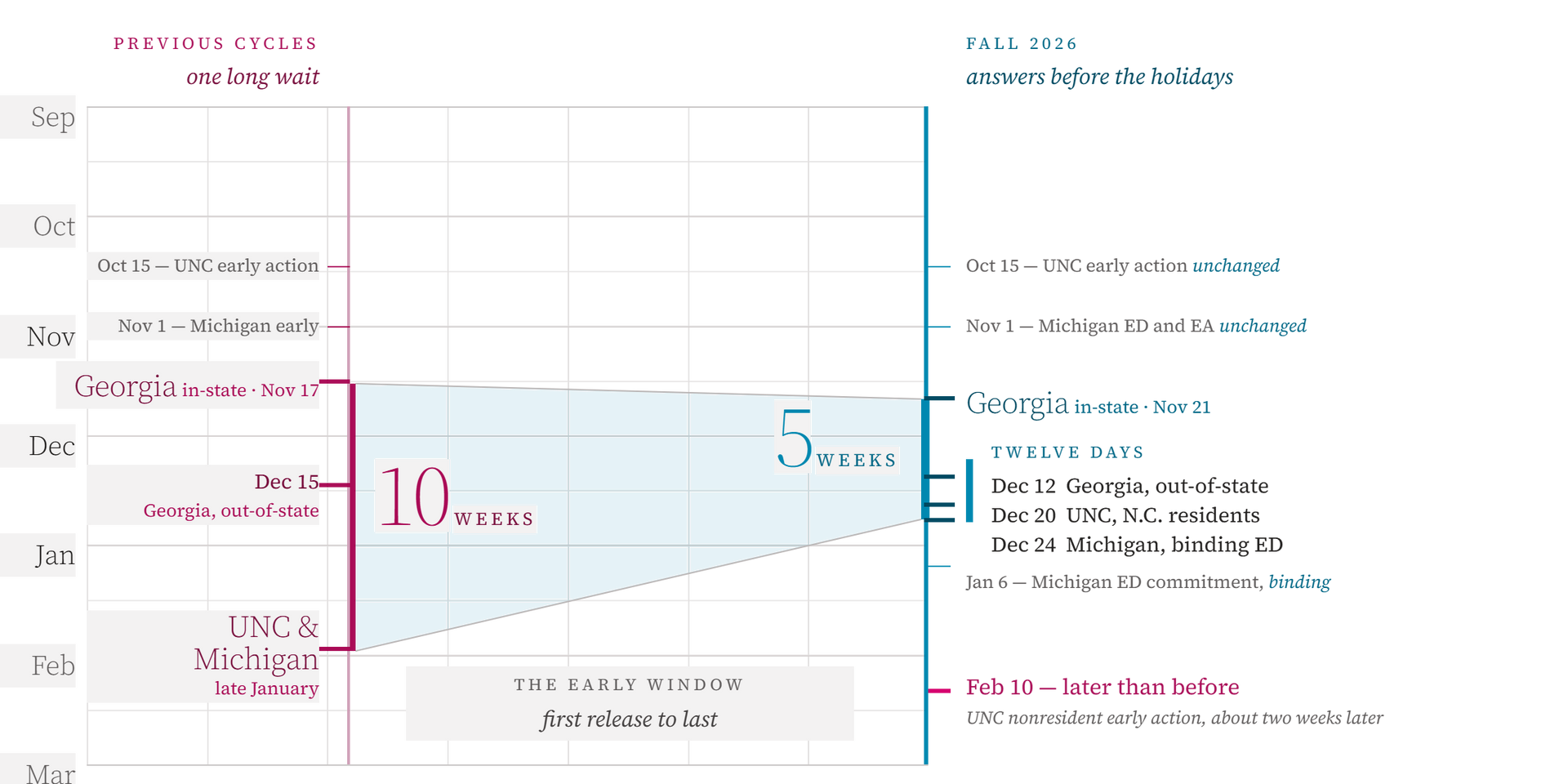
Three large public universities just gave counselors the same signal from three different directions. UNC-Chapel Hill moved its North Carolina early action decision release up by roughly a month. The University of Georgia's early action pool grew more than 12% in a single cycle to a record high. The University of Michigan added a new binding Early Decision option specifically because it expected — and got — a record number of total applicants. None of these three moves happened for the same reason, and none of the three schools coordinated with each other. But taken together, they describe the same underlying shift: early admissions cycles are moving faster and pulling in more of the applicant pool, and a counselor's fall workload is compressing along with them.
A note on timing, since it matters for how you read every number below: the most recently completed admissions cycle at all three schools is the one that applied in fall 2025 and enrolled as this fall's (2026) freshman class. That's the most recent cycle with final numbers, and it's what this article's application-volume figures describe. The current cycle — students applying this fall for entry in fall 2027 — is still in progress as of this writing, with early deadlines typically falling in mid-October. Where a school has stated its policy for the current cycle directly (UNC has), that's noted explicitly. Where it hasn't, treat last cycle's numbers as the most relevant available baseline, not as proof of what this cycle will do.
This is also a smaller story than a policy reversal — nobody is eliminating early action or changing who's eligible. It's an operations story. The practical question it raises is when a counselor's early-cycle work actually needs to happen, and how much of a family's decision-making window has quietly shrunk without anyone announcing it as a headline change.
What Changed Last Cycle, and What's Confirmed for This One
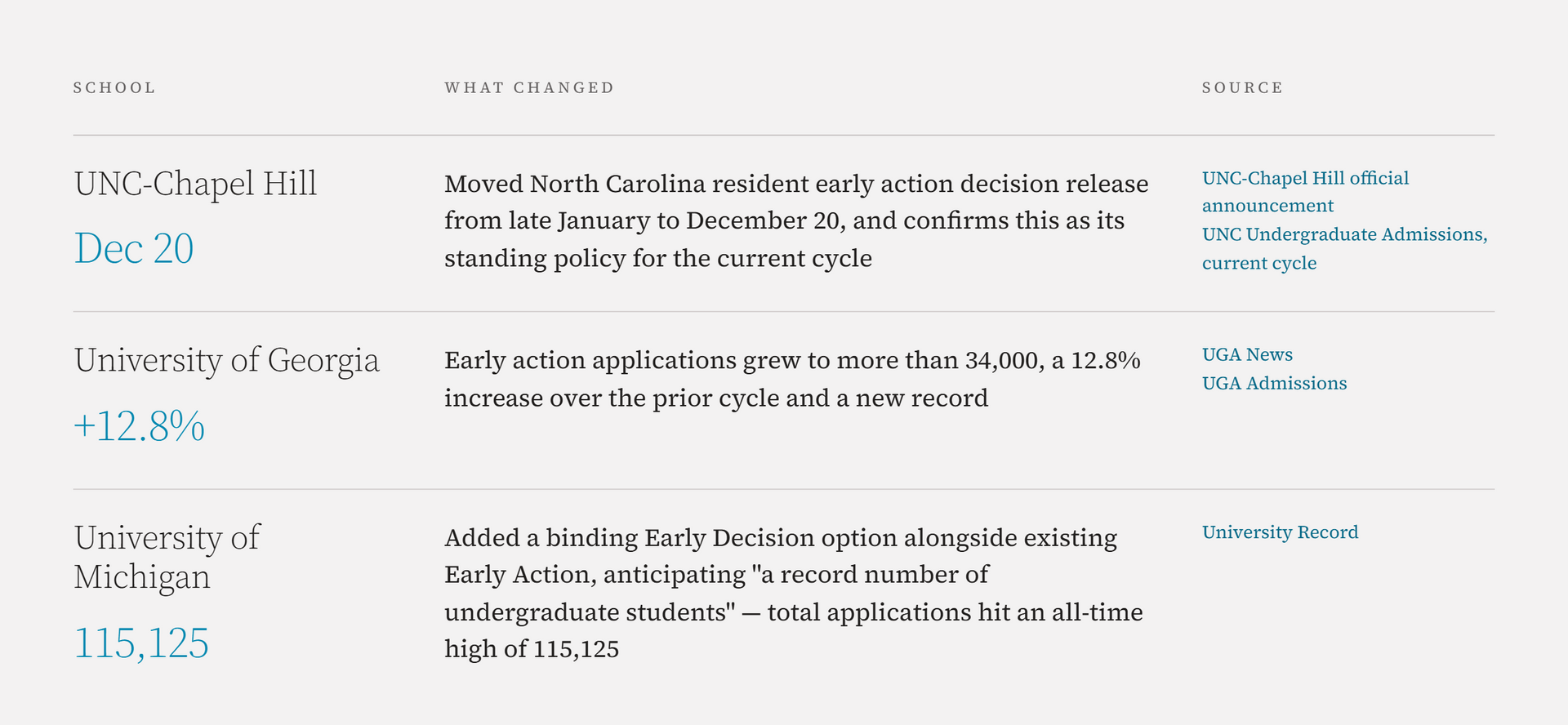
UNC-Chapel Hill: the decision itself arrives sooner — and this is confirmed as standing policy, not a one-time change
A note on timing before the numbers: UNC first made this change for the cycle that applied in fall 2025 and enrolled as this fall's (2026) freshman class — those students are already on campus. That's worth being precise about, because it's tempting to describe a recent-sounding change as if it applies to whoever is applying right now. It does, but that's a separate fact, verified separately below, not something the fall 2025 numbers themselves prove.
UNC's change is the cleanest of the three, because it's a direct, announced policy shift rather than an emergent trend in application numbers. Vice Provost for Enrollment Rachelle Feldman explained the reasoning plainly: moving North Carolina early action notifications to December 20 — before winter break, instead of late January — was meant to "ease the stress of decision making and planning" for in-state families. UNC's admissions office consulted high school counselors ahead of the change and reported "overwhelmingly positive feedback" that earlier notification would help students and families plan.
That first cycle backed up the reasoning with real numbers: 14,931 North Carolina early action applications for the fall 2026 entering class, a 2.75% increase over the prior year, resulting in 5,903 admitted students who learned their outcome about a month sooner than an equivalent applicant would have in earlier cycles.
Here's the part that matters for anyone advising a student applying right now, for fall 2027 entry: this isn't a one-year exception. UNC's own undergraduate admissions page, current as of this writing, states the decision timeline as a standing policy — "By December 20 for North Carolina residents and by February 15 for all other applicants" — with no indication it was a single-cycle experiment. A North Carolina student applying by this October 15's early action deadline should plan on a decision by December 20, 2026, not late January.
Georgia: the same calendar, a bigger pool moving through it
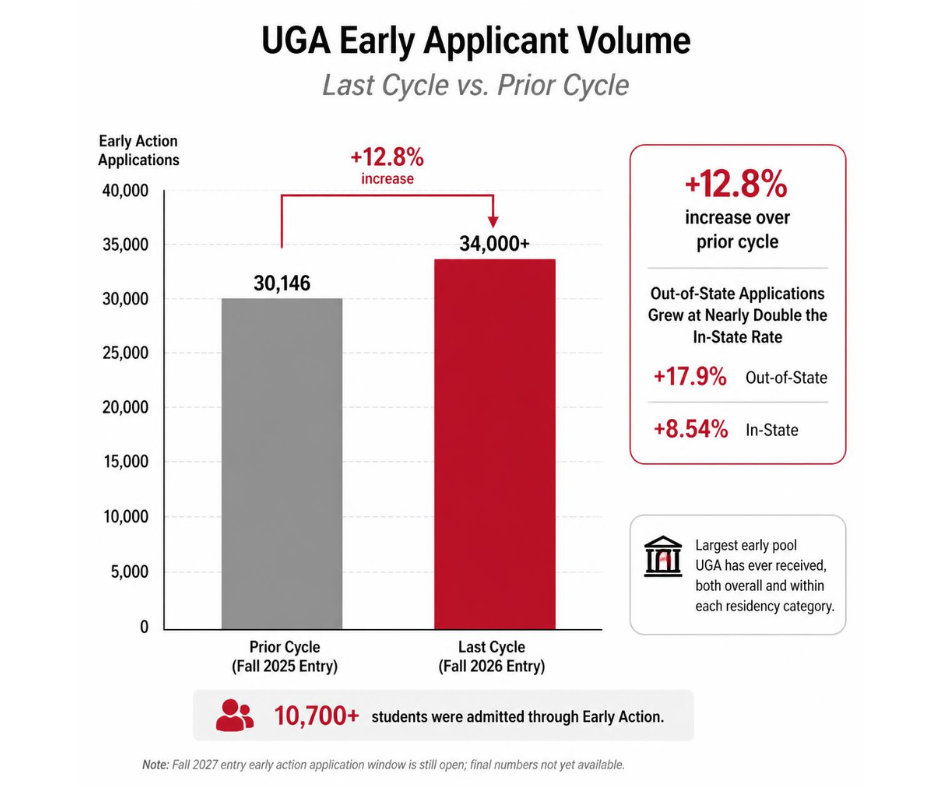
UGA didn't change its early action timeline. What changed, in the most recently completed cycle, is how many applicants moved through that same window. For the fall 2026 entering class, the university received more than 34,000 early action applications — a 12.8% increase over the prior cycle, with out-of-state applications growing at nearly double the in-state rate (17.9% versus 8.54%). UGA's own admissions office called it, in its own reporting, the largest early pool it had ever received, both overall and within each residency category. More than 10,700 students were admitted through early action.
I don't have UGA's application count for the cycle currently in progress (fall 2027 entry) — that window is still open as of this writing, so a final number doesn't exist yet. What last cycle's record does establish is a clear baseline and direction: the same admissions staff, working the same October-to-December calendar, processed a meaningfully larger file than the cycle before it. Whether that keeps compounding is a fair thing to watch this fall, not something already confirmed. Either way, it's relevant to counselors now, since a growing early applicant pool at a fixed-capacity school can shift the odds calculus for an individual student even when nothing about that student's own file has changed.
Michigan: a new early lane, and a nuance worth flagging
Michigan's story is the most interesting of the three, and also the one where the headline number needs a caveat — on top of the same cycle-timing caveat that applies to Georgia above. The university added a binding Early Decision option for the fall 2026 entering class — its first-ever ED program, running alongside the existing nonbinding Early Action track — specifically because it was anticipating record demand. Provost Laurie McCauley framed the new option as giving admitted students a chance to "affirm their commitment to the university earlier in the application process and enjoy peace of mind during the rest of their senior year of high school." As with Georgia, I don't yet have a final count for the cycle currently in progress; Michigan's admissions office has not, as of this writing, published early-cycle figures for fall 2027 applicants.
For that most recently completed cycle, the university did set a record: 115,125 total applications, a 29% increase over five years, with nearly two-thirds of that pool — 71,893 students — applying through one of the two early pathways. That is a genuinely large early-cycle number.
Here's the caveat: Michigan's own reporting also states that first-year applications specifically were down slightly from 2025. The record in total applications was driven in part by transfer application growth and by the debut of the new Early Decision channel, which likely pulled some students who would have applied Regular Decision anyway into an early bucket. Michigan's own published reporting doesn't state that early-cycle volume, in isolation, set a year-over-year record — only that total applications did, and that early pathways now account for most of the applicant pool. Counselors should read "Michigan had a record early cycle" as directionally true but not as precisely proven by the numbers Michigan itself has published. The clearer, defensible claim is: Michigan restructured its early options specifically because it expected pressure on capacity, and roughly two out of three applicants are now choosing an early path of some kind.


Why This Counts as a Pattern, Not Three Coincidences
None of these three schools cited each other, and none of this reflects a coordinated policy from the Common Application or a national admissions body — this is professional interpretation, not a documented causal chain. But the three data points share a common shape: decisions arriving earlier (UNC), a larger share of the class being decided in the early rounds (Georgia), and a school actively restructuring its early options because it expects more applicants to want an early answer (Michigan). Each is a different mechanism producing the same outcome — the early admissions calendar is absorbing more of a counselor's total workload for a given student, and it's absorbing it earlier in the fall than it used to.
A Note on the Data Behind This Analysis
This analysis is built entirely from each university's own public reporting — admissions office announcements, official university news bureaus, and in Michigan's case, its University Record — not from CounselMore's own platform data. CounselMore does not currently have proprietary data on client-side early application timing or outcomes at these three specific institutions; if that data existed, it would be a natural way to test whether CounselMore families are already responding to compressed timelines faster than the general applicant pool, or lagging behind it. That's flagged here as a genuine open question, not something this article can currently answer.
It's also worth being explicit about scope: three schools is not a systematic national study. UNC, Georgia, and Michigan are all large, well-resourced public flagships, and this pattern may not generalize cleanly to smaller or private institutions with different admissions infrastructure. Treat this as three concrete, well-documented data points that point in the same direction, not as proof of a universal trend.

What This Means for Counselor Workflow
Move your own early-cycle prep earlier, not just the student's application. If a target school is releasing decisions a month sooner, the counseling relationship's post-decision work — financial aid comparison, deposit deadlines, second-choice conversations — also needs to start a month sooner. A workflow built around a late-January UNC decision no longer matches reality for North Carolina applicants.
Recalculate odds conversations for high-volume early pools. A student applying early to a school with a meaningfully larger applicant pool than last cycle is not applying into the same environment their older sibling did two years ago, even if the school's stated admit rate looks similar. This is a place where "the process is the same, just check the box" advice undersells what's actually changed.
Ask early about binding options before defaulting to nonbinding. Michigan's new Early Decision option is a reminder to build a specific conversation into every fall intake: does this family understand the binding commitment, and is an ED application to this specific school actually the right strategic choice, or is it happening by default because it's newly available? A new option isn't automatically the right option for a given student.
Rebuild the assumption that "early" means "later in senior fall." All three data points point the same direction: more of the admissions calendar is happening earlier. Counselors who still mentally file early-cycle work as a December-and-January task risk being structurally behind for the families who need decisions and next-step planning as soon as mid-December.
Frequently Asked Questions
Did UNC change its early action timeline for all applicants, or just North Carolina residents?
Just North Carolina residents. UNC's announcement specifically moved up decision release for in-state early action applicants; the university's own communications don't describe an equivalent change for out-of-state early applicants.
Is Michigan's total application record actually an early-admissions record?
Not precisely, based on what Michigan has published. The 115,125-application record is a total-applications figure, driven partly by transfer growth and a new Early Decision option. First-year applications alone were reported as down slightly from 2025. The more defensible claim is that Michigan restructured its early pathways in anticipation of sustained demand, not that early volume itself set an isolated record.
Does a bigger early applicant pool at a school like Georgia mean a lower admit rate for early applicants?
Not necessarily, and this analysis doesn't claim that. UGA's own reporting shows admitted-student counts grew alongside the applicant pool (more than 10,700 admitted last cycle). A larger pool and a lower rate can move together, move independently, or move in opposite directions depending on how much a school's colleges expand capacity — that's a separate question this data doesn't answer.
Conclusion
None of these three changes, on its own, would be much of a story. Together, they're a reasonable early signal that the admissions calendar counselors have built their fall workflow around is shifting underneath them — earlier decisions, bigger early pools, and new early options designed around the expectation of more demand. The practical implication isn't alarm. It's recalibration: treat early-cycle prep, family communication, and post-decision planning as fall-semester work that increasingly can't wait until the calendar used to say it was due.
Have data on how your own early-cycle timeline compares to what's described here? Explore more Insider's Edge research on admissions trends and counselor workflow.
You, too, can submit your blog to CounselMore. See the CounselMore Guest Blogging Guide to learn how.