UT Austin's "Optional" Resume Isn't Optional At All — Here's Proof
By Kristin Haddad, Author and Higher Education Professional, Golden Gate College Counseling, Emeriti | Insider's Edge, published by CounselMore

Every fall, I get a version of the same phone call. A parent found my number after Googling something like "does UT Austin require a resume," and they're confused. Their student's counselor said it's optional. Their neighbor's kid got in without one. But their cousin in McCombs swears her daughter's five-page activity resume is the reason she got into Business Honors. So which is it? Is UT Austin's obsession with resumes real, or is it just admissions folklore parents pass around at soccer games?
I looked into this closely, because I get asked about it constantly. The honest answer is: it's both. UT Austin's resume is officially optional and unofficially one of the most important documents in the entire application. Let me walk through what UT's own materials actually say, so you can guide your student — or your client's student — correctly instead of guessing.

What UT Austin Actually Asks For
Here's the part that trips everyone up. On UT Austin's freshman application materials page, a resume falls under "Optional Materials." The official language is blunt about it: those items are "NOT required for admission consideration." Read quickly, that sounds like a green light to skip it.
But UT doesn't stop there. The same page invites applicants to "submit a resume offering additional information about your achievements, activities, leadership positions and student employment" — and admissions professionals who work with UT applicants every year consistently describe the document as one of the most useful parts of the application after academic performance. That's a real gap between "not required" and "worth doing well." It's the whole story.
The Expanded Resume, Specifically
What most families are actually talking about isn't a one-page job-style resume. It's what counselors call the "expanded resume" — a document that can run two to four pages, sometimes more for a highly involved student. It's meant to capture everything the Common App's cramped activity section can't: grade level, hours per week, weeks per year, and a real description of what the student actually did, not just a title.
UT Austin's honors programs make this even clearer. Plan II Honors, for example, tells applicants outright that formatting doesn't matter but detail does. Their guidance says "a two or three page resume is fine if that's what's necessary," and explicitly warns students that "the expanded resume absolutely need NOT be limited to one page" — in other words, don't be overly concise. They want to know if a leadership title was earned or appointed, exactly what the role involved, and how many hours a week it actually took. Plan II is direct about the two things that actually hurt an applicant here: "dishonesty and over-generalizing" — not brevity, and not imperfect formatting. That's not a program treating the resume as an afterthought.
Some Honors Programs Don't Just Recommend It — They Require It
If Plan II treats the resume as close to mandatory in practice, the
Canfield Business Honors Program (CBHP, formerly known simply as Business Honors) removes any ambiguity: a standalone, expanded resume is a required part of the application, uploaded separately through MyStatus or the Common App documents section. CBHP's own instructions are explicit that "the Activities section of CommonApp does not meet the resume requirement" — a separate document must be provided. So the family whose cousin swore her daughter's detailed activity resume "got her into Business Honors" wasn't repeating folklore. For that specific program, the resume isn't an optional nice-to-have at all; it's a checklist item, and an incomplete one can leave an otherwise qualified application short of complete.


Why the Resume Carries So Much Weight
The reason comes down to how UT Austin actually reviews applications. UT's own review and decision process page describes an individualized, holistic review that evaluates each application "in relation to the admission factors for the University and for the college, school and majors to which you apply," and explicitly lists "competitiveness of the major you applied to" as one of the factors considered. Admissions consultants often shorthand this as a "fit-to-major" review: reviewers aren't just asking "is this a strong student," they're asking "does this student's record support the specific major they're applying to."
A biology major with three years of hospital volunteering and a research mentorship tells a very different story than a biology major with the same GPA and no related activity at all.
The resume is where that story gets told. The Common App's activity list gives a student ten slots and a couple hundred characters each. It's built for breadth, not depth. The expanded resume is where a student can actually show a reviewer, in detail, why their extracurricular life supports the major they've chosen — which matters enormously at a school built around major-specific review.
So: True or Hype?
True. But with an asterisk that matters for how you advise families.
It's true that the resume isn't a paperwork formality — it's one of the clearest ways a student can influence a "fit-to-major" decision that the transcript and test scores alone can't make for them. It's true that certain honors programs, like Plan II, treat it as close to essential in practice, even when the general application labels it optional. And it's true that admissions professionals who watch UT's process closely consistently rank it as high-leverage.
It's hype, though, when parents treat it as a magic document that will rescue a mismatched application, or when a student pads three pages with generic filler just to hit a page count. UT's own guidance is explicit that vague, inflated entries hurt more than a shorter, honest one. The resume amplifies a genuine fit. It doesn't manufacture one.

What This Looks Like in Practice
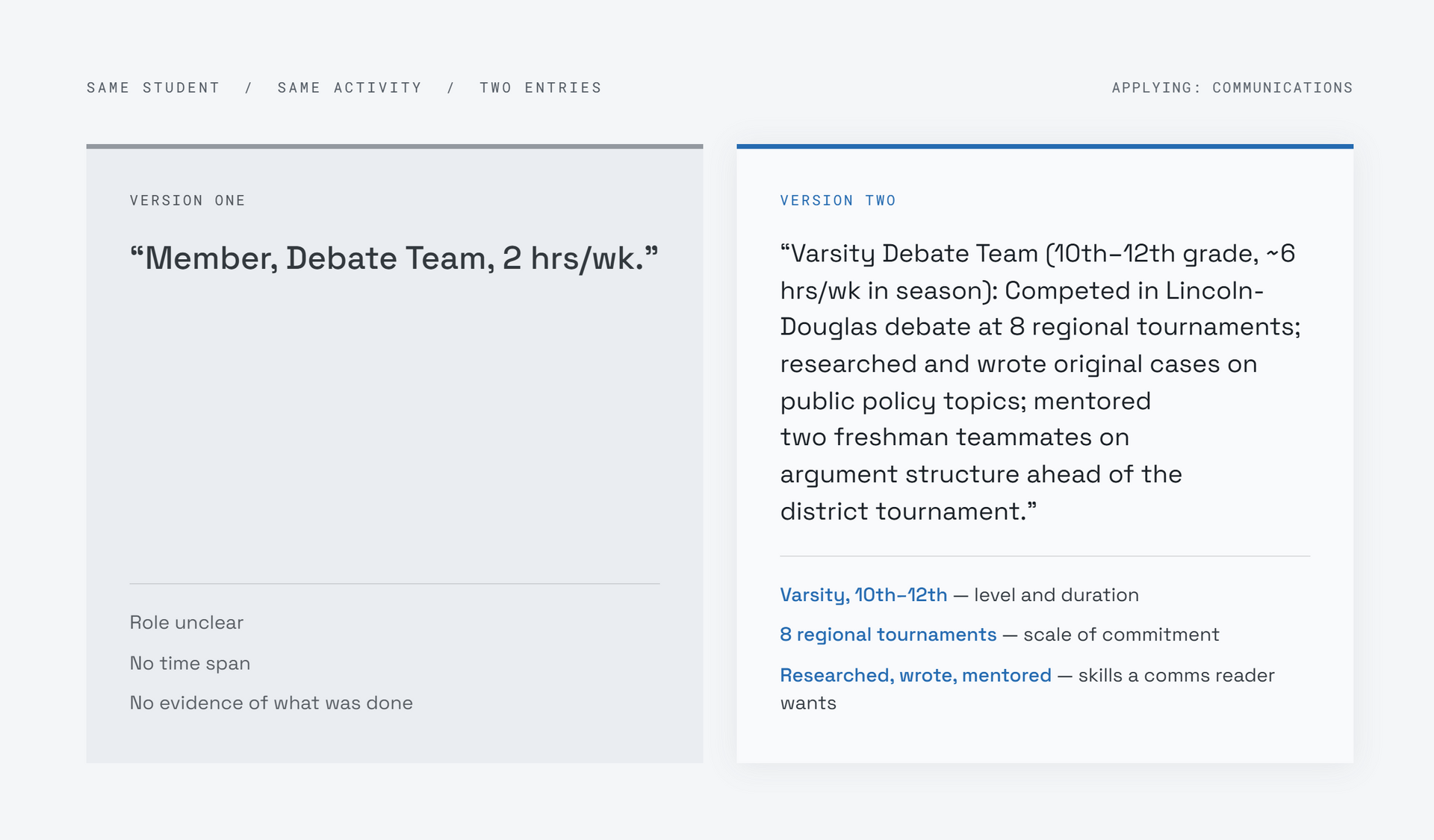
Compare these two entries for the same student, applying to a communications major:
Version one: "Member, Debate Team, 2 hrs/wk."
Version two: "Varsity Debate Team (10th–12th grade, ~6 hrs/wk in season): Competed in Lincoln-Douglas debate at 8 regional tournaments; researched and wrote original cases on public policy topics; mentored two freshman teammates on argument structure ahead of the district tournament."
The first tells a reviewer almost nothing. The second shows sustained commitment, real hours, a skill set that maps directly onto a communications major, and even a leadership thread. That's the difference between a resume that sits in the file and one that does work for the student.
What Families Should Actually Do
For this cycle, here's the practical guidance I give clients: build the expanded resume early, and build it around the intended major, not just a chronological list of everything the student has ever done. Start the inventory as early as the summer before ninth grade if there's time, and organize entries by relevance to the major rather than strict date order. Include hours per week and weeks per year for everything — UT's own honors programs ask for this specifically. And be honest. UT is explicit that the two things that actually hurt a resume are dishonesty and over-generalizing, not brevity.
This is also worth flagging for families applying to Plan II, Canfield Business Honors, or any of UT's other honors tracks: check that program's own application page for resume guidance, since several honors programs go well beyond the general application's "optional" language — and for programs like CBHP, treat those instructions as literally required, not a suggestion.

For Counselors: Building This Into Your Own Practice
If you advise students applying to UT Austin, this is worth turning into a standing step in your workflow rather than a one-off conversation. Two habits make the difference:
- Check program-level requirements before you check the general application. UT's freshman application page tells you what's true at the university level. It does not tell you what's true for Plan II, Canfield Business Honors, the Turing Scholars program, or any other honors track a student is applying to. Build a habit of pulling up that specific program's admissions page every cycle — not from memory, since program names and requirements do change, as the shift from "Business Honors" to "Canfield Business Honors Program" shows.
- Treat the expanded resume as a drafting project, not a formality. Because UT and its honors programs explicitly want hours per week, weeks per year, and a real description of duties, this document benefits from the same iterative review you'd give a personal statement — not a five-minute pass the week before the deadline.
Frequently Asked Questions
Is a resume required for UT Austin's general freshman application?
No. UT Austin's freshman application materials page lists it as optional and states plainly that optional items are "NOT required for admission consideration." Whether it's worth submitting anyway depends on the strength and depth of the student's activities.
Which UT Austin honors programs actually require a resume?
The Canfield Business Honors Program (CBHP) requires a standalone, expanded resume as part of its application — the Common App Activities section does not satisfy this requirement. Plan II Honors doesn't technically require one but provides detailed guidance suggesting it's treated as essential in practice. Always confirm current requirements directly on each program's admissions page, since these can change between cycles.
Does the general application's "optional" resume still matter if a student isn't applying to an honors program?
It can. UT's holistic, major-based review considers how well an applicant's record supports the specific major applied to. A well-built resume gives reviewers detail the Common App's activity list can't — but it's a genuine option, not a required checklist item, outside of programs that explicitly require it.
Ready to Get This Right the First Time?
If you're navigating UT Austin's application for your own student — or you're a fellow counselor building this guidance into your own practice — don't let "optional" cost your family a program they were genuinely qualified for.
You, too, can submit your blog to CounselMore. See the CounselMore Guest Blogging Guide to learn how.