The Ivy League's Testing U-Turn Is Almost Complete — Here's What That Means for This Year's Applicants
By Kristin Haddad, Author and Higher Education Professional, Golden Gate College Counseling, Emeriti | Insider's Edge, published by CounselMore
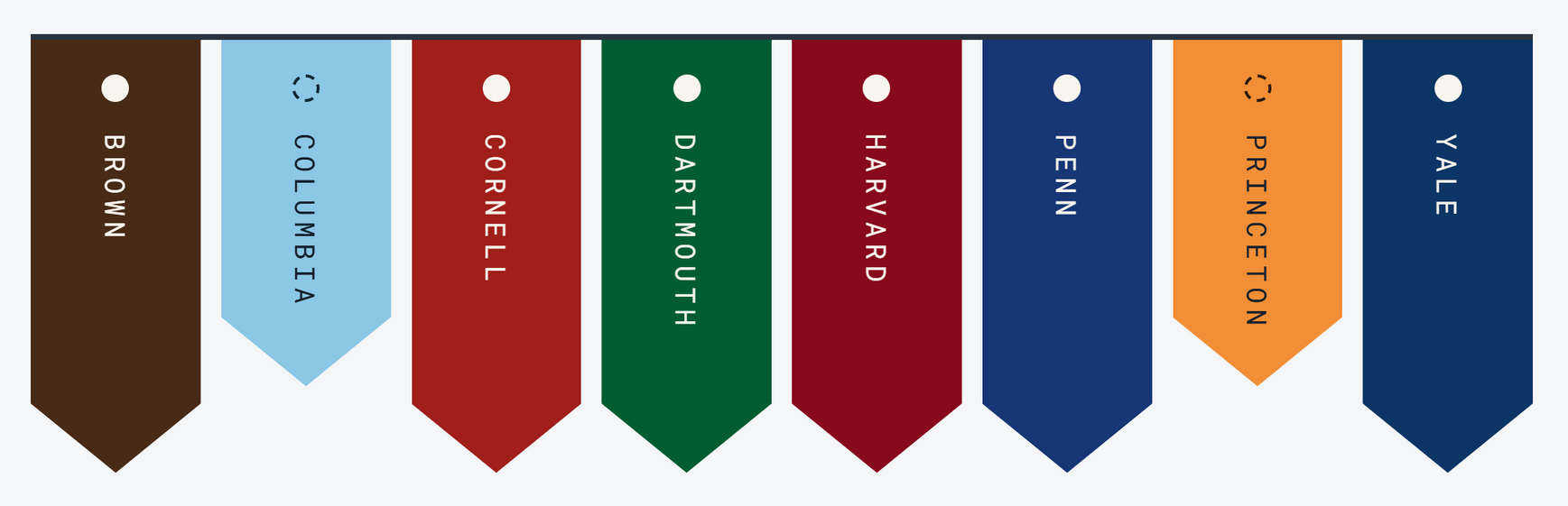
As of this admissions cycle, six of the eight Ivy League universities require SAT or ACT scores. The other two — Princeton and Columbia — have already told the world exactly when they're joining them: fall 2027 applicants. Which means the test-optional era at the Ivy League isn't fading out gradually. It has an expiration date, and that date is one admissions cycle away.
If you're advising families right now, that's not a trend to mention in passing. It's a planning fact that changes what a sophomore should be doing this year, what a junior needs to lock down by spring, and what a senior applying test-optional to Princeton or Columbia this fall should understand about their window closing behind them.
Where Every Ivy League School Stands Right Now
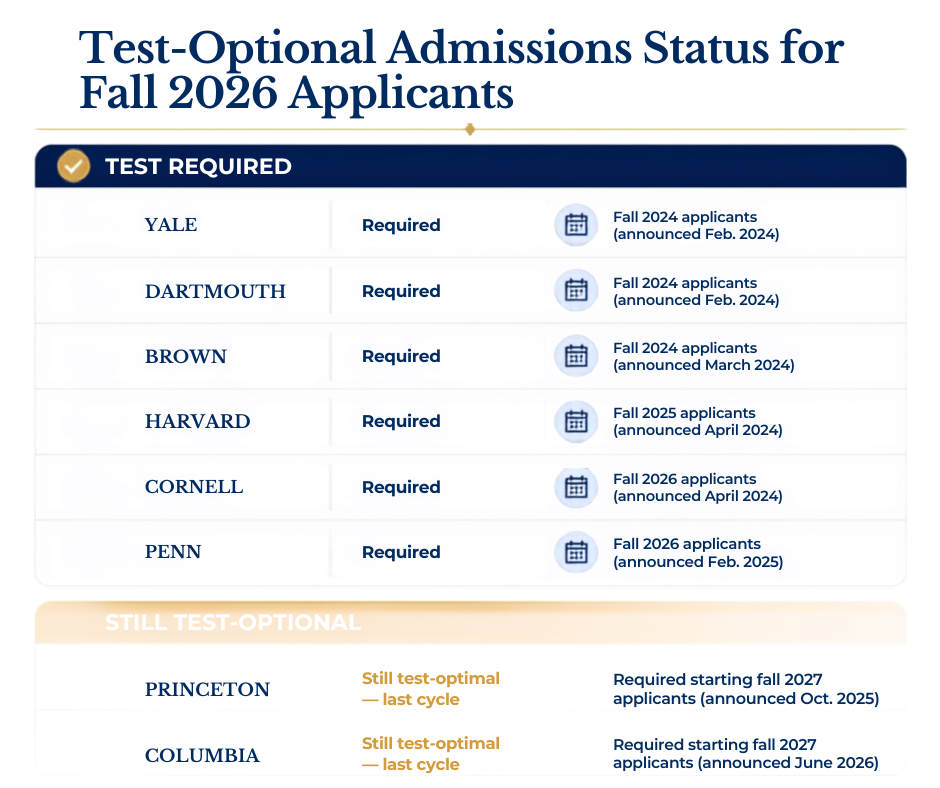
Here's the exact status of each school, sourced directly from each university's own admissions announcement — not a secondhand summary, since several of the roundup lists circulating right now get this wrong (Compass Prep's own widely-cited testing tracker still lists Harvard as test-optional as of this writing, and it currently is not).
Why Schools Are Reversing Course
The rationale schools give isn't "we miss the SAT." It's a specific, research-backed argument, and Dartmouth's is the most fully documented version of it. When President Sian Leah Beilock announced Dartmouth's reversal, she cited an internal analysis spanning years when testing was both required and optional, with two findings that mattered:
Test scores turned out to be a stronger predictor of success in Dartmouth's own curriculum than grades or recommendations alone, regardless of a student's economic background. And test-optional policies had an effect nobody intended: the university was "unintentionally overlooking applicants from less-resourced backgrounds who could thrive" there, because a score gives reviewers context a transcript alone can't — a 1400 SAT from a high school where the average is 1000 tells reviewers something a 3.9 GPA by itself doesn't.
Dartmouth's announcement didn't pretend the tests are perfect. It acknowledged directly that "SAT and ACT scores reflect inequality in society," and argued that combined with expanded financial aid, a testing requirement lets the school identify talented students it was otherwise missing — not that testing alone levels the field. Other schools reversing course have made close variations of the same case: scores add predictive information current holistic review doesn't reliably get elsewhere, especially for applicants without access to the kind of school profile, counselor letter, or extracurricular record that signals strength to a reviewer who's never heard of their high school.
The Data Backs This Up: Applicants Are Already Responding
This isn't just a policy story — behavior is already shifting to match it. Common App's own March 2026 data report, covering the current cycle through March 1, found that for the first time since the pandemic, more applicants submitted test scores than withheld them. Score submissions rose 22.9% over the past two years, compared to just 6% growth in the two years immediately following COVID's onset — a sharp acceleration, not a gradual drift.
That's the confirmation that families and their counselors are already treating "test-optional" as a shrinking option rather than a permanent one, well before the last two Ivies made their reversals official.
It's Not Just the Ivy League
The testing reversal isn't confined to eight schools in the Northeast. Vanderbilt, Claremont McKenna, and Auburn all moved to required testing for the 2025-26 cycle. Carnegie Mellon's requirement now varies by which of its schools a student applies to. Stanford, Caltech, MIT, Johns Hopkins, and UT Austin all reversed course earlier, alongside the first wave of Ivies in 2024.
It's not universal, though, and that matters for how you counsel students with a range of target schools. The University of California and California State University systems remain fully test-blind — they won't consider scores even if a student submits them. Pitzer College has committed to staying test-free through fall 2027. And plenty of strong, less hyper-selective schools remain genuinely test-optional with no announced end date. The pattern isn't "testing is back everywhere." It's "testing is back at the schools that get the most applications relative to their class size," which is precisely the segment where a stronger application file matters most.

This Is the Last Cycle to Apply Test-Optional to an Ivy League School
Worth saying plainly, because it's easy to miss in a list of policy dates: a student applying to Princeton or Columbia this fall is applying during the last cycle either school will consider an application without scores. Next year's applicants won't have that option anywhere in the Ivy League.
That has a specific, practical implication for a current senior with a genuinely weak testing history who was counting on Princeton or Columbia's test-optional status as part of their strategy — it's real, but it's also the last time it will be. And it has a different implication for current juniors and sophomores: don't build a college list around the assumption that an elite school without a testing requirement will still be true when they apply. Assume the opposite, and be pleasantly surprised if it isn't.
What This Means for How You Advise Families Right Now
For current seniors (applying this fall): If a target list still includes any test-optional school, confirm that status directly on the school's own admissions page before finalizing a testing decision — don't rely on a list you found online, including this one, without a same-day check. Policies move fast enough now that even reputable trackers go stale within months.
For juniors: Treat scores as required for any competitive private university on the list, full stop, even where the portal still says "optional." A strong score is now a genuine asset almost everywhere selective; a decision to withhold one should be a deliberate strategic call for a specific school, not a default.
For sophomores and freshmen: This is the group where the shift actually changes long-term planning. Testing prep that used to start in earnest junior fall now needs to start earlier, because the safety net of "we'll decide test-optional versus test-submitted once we see the score" is disappearing at exactly the schools ambitious students are aiming for. Build a testing timeline into the freshman- or sophomore-year plan the same way you'd build in course selection.
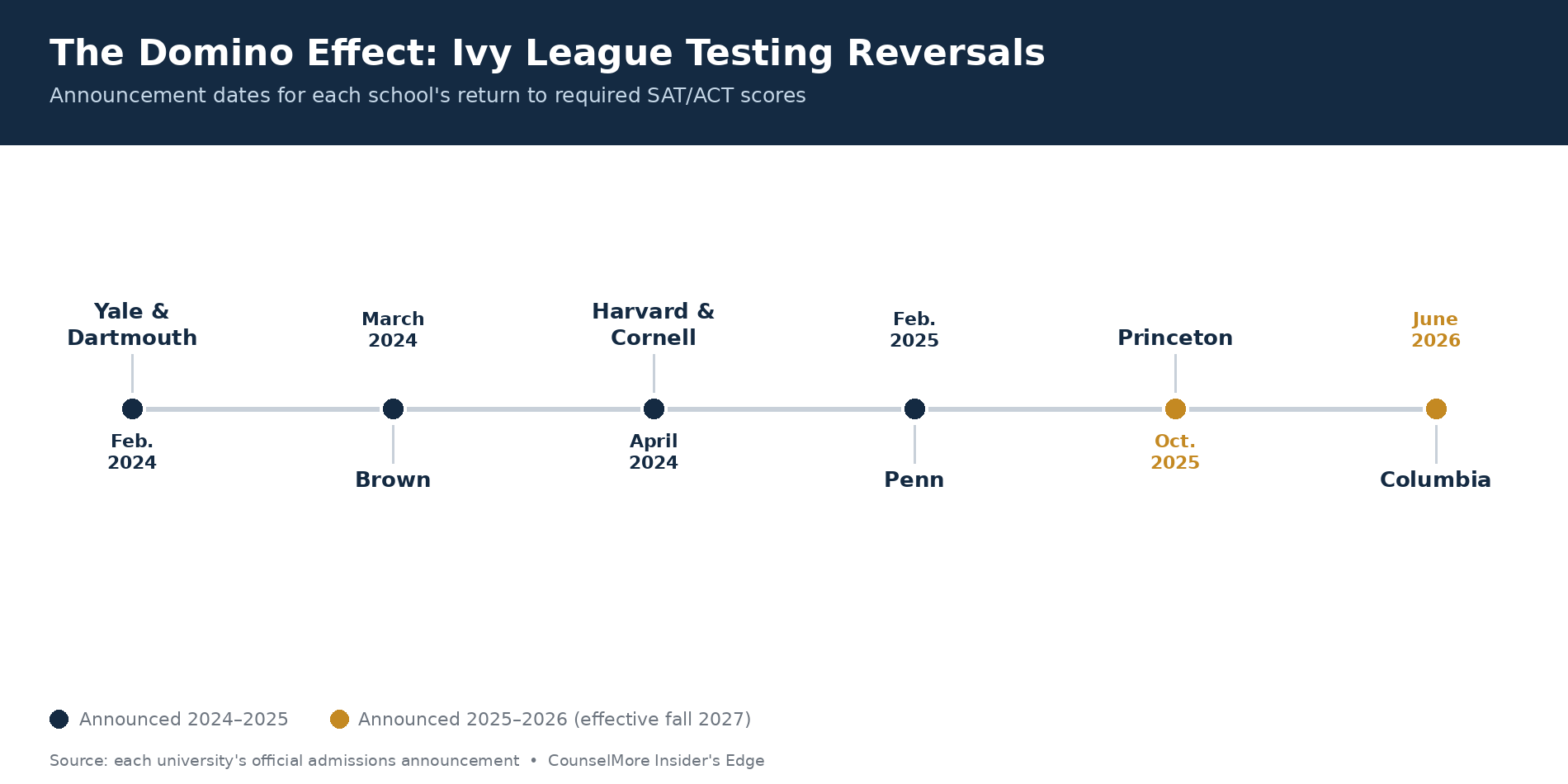
Across every grade level: Rebuild the habit of checking each target school's testing policy at the start of every planning conversation, not once at the beginning of the relationship. As this list shows, a policy that was optional in September can have an announced end date by June.

Frequently Asked Questions
Is Harvard test-optional?
No. Harvard reinstated its SAT/ACT requirement for fall 2025 applicants and it remains in effect. Several widely circulated testing-policy lists are out of date on this point — verify directly on
Harvard College's admissions site before advising a family based on a secondhand summary.
Which Ivy League schools are still test-optional?
Only Princeton and Columbia, and only through this current cycle (fall 2026 applicants). Both have already announced they'll require scores starting with fall 2027 applicants — meaning next year, all eight Ivy League schools will require testing for the first time since 2020.
Does test-optional still exist anywhere selective?
Yes — the University of California and California State University systems are test-blind, and a number of strong, less hyper-selective private and public universities remain test-optional without an announced change. The shift back to required testing is concentrated among the most heavily applied-to schools, not universal.
Should I have a sophomore start test prep now, even with two years until they apply?
Given how quickly "optional" has become "required" at the schools most students are stretching toward, yes — starting the conversation and an early diagnostic test in sophomore year is now a reasonable default, not an overreaction.
Ready to Get This Right the First Time?
Policies like these move fast, and the families you advise are counting on you to know the difference between what a school required last year and what it requires this one. If you're building this into your practice's own workflow, keep this page bookmarked and re-check it each admissions season — and if you want another set of eyes on how a specific client's testing strategy should account for these shifts, reach out.
SCHEDULE A CONSULTATION TODAY
You, too, can submit your blog to CounselMore. See the CounselMore Guest Blogging Guide to learn how.